Showing posts with label brown. Show all posts

Monday, 22 November 2010

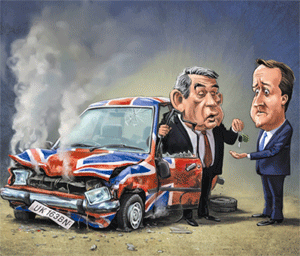
'Crash Gordon' handing keys to 'Etonian Cameron'


One picture is worth ten thousand words ... but IMHO the one below is priceless!


and will Cameron be the man to successfully turn things around (with the help of all his wealthy and privileged friends) ... ? 

to be continued ...


Sunday, 27 June 2010

Leaving Fantasy Island ... and Blair & Brown's Reality


Dan Atkinson recently provided a devastating analysis of Blair's Britain* - a hollow kingdom where we make nothing, but believe anything...


We all know what the Germans are good at. They do precision engineering: all those quietly humming washing machines and sleek cars. We also know that Germany is a country in serious trouble, failing to embrace the need for flexibility in the tough new global environment. We know this because Gordon Brown has told us many times over the past ten years that the European model is washed up. Germany was so abysmally competitive last year that it ran a record trade surplus and was the biggest exporter of any country in the world.

In the palm of Blair's hands... On Fantasy Island there are booming public services, low prices and millions of jobs. But Britain plc is actually surviving on hedge funds, hairdressers and celebrities.

We also know what the Japanese excel at. In Tokyo and Nagoya there are world-beating electronics companies. We know, too, that Japan, like Germany, is a country in serious trouble, persisting with an industrial model that may have worked in the Sixties and Seventies but is an anachronism in 2007. Poor Japan ran a trade surplus of about £50 billion last year as it found a ready market in China for its exports.

And so it goes on.

The French have an ultra-competitive manufacturing base that specialises in food and drink; the Scandinavians are a dab-hand at mobile phones; the Americans do computers, aircraft and films. So what is Britain good at? That?s simple. We count the money and we do the bull****.

Ten years after Tony Blair's arrival in Downing Street, Britain is a place whose default mode for earning its crust is to employ the gift of the gab.

The Germans may have the engineers, the Japanese may know how to organise a production line, but the Brits have the barristers, the journalists, the management consultants and the men and women who think that making up jingles and slogans to flog Pot Noodles is a serious job.

It has the deal-makers in the City who make fat fees by convincing investors to launch bids for companies, and the corporate spin-doctors who say that tycoon X will make a better fist at running Ripoff plc than tycoon Y.

It has the publishers and it has the 'film development' companies, some of which have actually been known to produce a film.

The four iconic jobs in today's Britain, according to the Work Foundation think-tank, are not scientists, engineers, teachers and nurses but hairdressers, celebrities, management consultants and managers.

In fact between 1992 and 1999, our fastest-growing occupation was hairdressing.

Before he came into politics, Blair was a lawyer. Brown's sole experience of the private sector was as a TV journalist. When you get down to it, this is a country that tried to make its living from talk, talk and more talk. But how has Britain fared when it comes to paying our way in the world?

Have the city traders and Groucho Club regulars earned enough to make the UK's age-old problems with the current account a thing of the past?

Sadly not.

Britain still has a world-class pharmaceutical industry and still makes a tidy sum from selling arms, often to unsavoury regimes.

Yet the deficit in visible trade in goods - stuff we make - was more than £60 billion in 2006.

Trade in services - accountancy, insurance, banking, architecture, advertising - brings that figure down but for the past decade, the only thing that has made the deficit manageable is that Britain has been earning more money on its investments abroad than foreign investors have made here.

One way of looking at Britain is as one big off-shore hedge fund churning speculators' money while asset-strippers draw up plans for the few remaining factories to be turned into industrial theme parks.

The truth is that after ten years, Blair's Britain is a fantasy island.

Mr Blair is currently obsessed with his legacy, but it makes most sense to think of him as a dreamer, a fantasist capable of getting millions of people to fantasise along with him. This is not simply a matter of the routine duplicity practised by politicians, but of living and believing a number of literally fantastical propositions.

Even in 1997 there was a strong dose of fantasy, with Mr Blair urging us to vote New Labour because (a) exciting, radical change would follow and (b) things would stay much as they had been. This should have been a warning sign but most voters ignored it. New Labour's fantasising became even much more ambitious. It is possible to identify seven deadly daydreams that  marked Blair's period in office.

DAYDREAM 1: 

The first daydream is the debt fantasy, in which vast amounts of consumer and mortgage debt can now be racked up either because the borrowing is secured on a home that has inflated in value, or because credit-card debt can be painlessly reduced or written off entirely through Labour's 'quickie' bankruptcies.

And billions of pounds of Government borrowings can be kept off the books by claiming them as part of the private finance initiative - a sort of hugely expensive mortgage scheme for public assets.

Between January 2000 and December 2005, the total outstanding on mortgage debt rose by 94 per cent and that on consumer credit by 65.8 per cent.

So what happened to earnings during that time? They rose by just 22.4 per cent.

Perhaps it is not surprising that more and more people are declaring themselves insolvent to escape their debts. In 2000, there were 21,550 individual bankruptcies in England and Wales, and 7,978 individual voluntary arrangements (IVAs), an alternative to bankruptcy in which some of the debt is written off. In 2006, there were 62,956 bankruptcies and 44,342 IVAs, increases of 192 per cent and 456 per cent respectively. More extraordinary is the fact that they have occurred during an economic boom rather than a grinding recession.

Scarcely less fantastical was the Government's own attitude to debt. Gordon Brown pledged that the State's budget for day-to-day spending (as opposed to investment) would be either in balance or surplus "across the economic cycle".

Given the Chancellor himself decides when the cycle begins and ends, he has been able to move it around to make the books add up. Initially, the cycle began in 1999 but then was moved back two years to allow Mr Brown to help himself in 2005 to long-spent money from the late Nineties.

When does the cycle end?

Take your pick - the Chancellor has said variously March 2006, March this year and in 2009.

DAYDREAM 2: 

The second fantasy concerns that sometime-never future, we will all work for the 'knowledge' economy, sometimes described by Ministers as the 'creative' economy.

Here, the line is that India and China may bag all the routine production work but Britain will do the clever stuff, whether investment banking, advertising, the media, law, the arts or writing witty scripts for Channel 4.

Now, it is quite true that Blair's Britain has given great importance to these lines of work. Self-promotion is the stock-in-trade of the iconic figures in our 'post-industrial' economy, whether the management consultant or the talent-free television celebrity.

But there is no good reason to believe that 'creativity' is going to close our yawning balance-of-payments deficit with the rest of the world, which has gone from being roughly zero when New Labour came to power to £43.4 billion in 2006.

France, Germany and Japan make things that people wish to buy. We do not. It is as simple as that.

Despite the beaming encouragement of a guitar-strumming Mr Blair, our cultural exports are flailing in an ultra-competitive world. In 2005, we imported more TV programmes than we exported, running a deficit of £332 million.

And what of music, a major money-spinner since the days when The Beatles conquered America?Well, the best seems to be behind us, with the U.S. market share of British acts tumbling from 32 per cent in 1986 to 0.2 per cent in the early part of this decade. The British band that attracted most attention in America last year was not Arctic Monkeys but The Who.

At home, numbers employed in advertising and design have gone down. In fact, there are three times as many people working in domestic service than in advertising, television, films, video games, the music business and design put together. Remarkably, there are about four million people 'in service'.

Britain is not a creative economy, but a cooking, cleaning and call-centre economy in which millions are toiling away in low-paid, low-skilled jobs.

Even were the state of our education system not to make the emergence of a knowledge economy seem rather less likely than an ignorance economy, it is laughable (and derogatory) to imagine that people in developing countries somehow lack our creative spark.

It is almost the mirror image of the Victorian notion of Western practicality and Eastern mysticism.

DAYDREAM 3: 

New Labour's third fantasy concerns prices and earnings. There is no doubt that, across the board, a number of previously costly items and services have fallen in price and are sometimes provided free.

This includes telephone services, clothing, home-entertainment equipment, airline travel and food.

But many of the price falls of recent years have not been quite what they seemed.

In May 2004, economist David Hillier identified a new phenomenon - "stealth inflation" - in which the quality of goods declines along with the price. Mr Hillier identified shirts, garden furniture, napkins, matches and bin liners as examples of products getting even-thinner and less durable.

He could also have cited towel rails apparently made out of silver paper, kettles and CD players that break down shortly after the guarantee expires, and dishwashers that are good at washing dishes provided the dishes have been cleaned first.

Furthermore, the next wave of price reductions may be rather less amenable for Middle Britain, focusing less on manufactured goods and more on services provided by middle-class professionals.

Law, accountancy and design could all be subjected to price-cutting, as in the proposal to let supermarkets offer legal advice.

Ministers have basked in the feelgood factor of lower prices without once bothering to explain that, ultimately, prices and earnings are likely to move up and down together.

How could it be otherwise?

It cannot, of course, other than on that holiday haven of unreality, Fantasy Island.

DAYDREAM 4: 

A fourth New Labour delusion was that the public sector had been "reformed" and that colossal increases in expenditure had been prudently spent in carefully structured, "customer-focused" services committed to "delivery".

It is true that they have spent a fortune during their ten years in power, with public spending having increased from £309.1 billion in 1996-1997 to a forecast £586.6 billion in 2007-2008, a rise of more than 89 per cent.

Mr Blair had no doubt this money had been well spent, telling his farewell party conference: "Over the past ten years Britain has invested more in our public services than any comparable nation in the world."

The key word here is "invest", with its associations of rectitude. In this pipe dream, a near doubling in spending has been matched by a near doubling (at least) in "delivery".

This fantasy seems impervious to events in the real world, in which hospitals slide into debt and announce job cuts, in which illiteracy and innumeracy run rife in State schools and in which management consultants and firms involved in private-finance deals effectively help themselves to billions of pounds of public money.

DAYDREAM 5: 

Work is the focus of the fifth fantasy, the hallucination that despite us living in a tough, competitive world, we can pass huge quantities of employment regulation to make employees' lives ever more agreeable and that it is perfectly safe to expand the workforce, through immigration and other measures, far beyond the economy's likely ability to create jobs.

On Fantasy Island, the labour market catchphrase is: "From next April..." Whenever you hear this, you know that what follows will be some new set of legal entitlements for the nation's employees.

All well and good, but the same Ministers repeatedly warn us that India, China and other emerging competitors mean we have to be ever more flexible and productive.

Of course, it could be that we are looking at the issue through the wrong end of the telescope and that it is not the muddle-headed policy of trying to combine employment rights with a flexible labour force that is supposed to build a strong labour market, but the strong labour market that allows Ministers to pursue the muddle-headed policy.

On the surface, the job scene is brighter than at any time since the mid-Seventies, with unemployment well below one million, down from 1.7 million in March 1997.

But dig a little deeper and things look less cheery.

First, despite steady advances in healthcare, there are now about 2.5 million adults of working age too ill or disabled to hold down a job, four times the figure in 1979. Nor is this the only way of 'parking' people who may otherwise be counted as unemployed.

Numbers entering higher education have shot up, as has the State's own payroll - up by 600,000 people, or 13 per cent, on 1997.

Were this to be straightforward cynicism on the part of Ministers, it would be bad enough. But it seems they have fallen for their own propaganda and having caused one chunk of the workforce to disappear in a puff of smoke, have then conjured another into existence, encouraging migrants, mothers and older people into the labour market.

In their imaginings, they believed the British economy could bear any burden in terms of regulation and numbers of jobseekers and still produce millions of jobs.

Sad to say, this notion is indeed entirely imaginary.

DAYDREAM 6: 

Fantasy six involves conjuring up a military role for Britain without paying for it, of trying to fight wars on a peacetime budget. Mr Blair wanted Britain to play the part of a latter-day Prussia with military resources more suited to a latter-day West Germany.

While our troops have been despatched to Kosovo, Sierra Leone, Afghanistan and Iraq, they have gone into battle on a shoestring. In 2002-2003, total public spending at the Ministry of Defence was £35.4 billion. The planned total for the current year is £39 billion, a ten per cent rise.

Given the two per cent inflation target, the increase ought to have been at least 14 per cent. In stark contrast is the 54.8 per cent rise in spending on education in England over the same period.

Rather than spell out the costs of military grandeur in terms of either higher taxes or cuts in other types of public spending, Mr Blair preferred big-power status on the cheap.

With troops' lives at risk in Iraq and Afghanistan for want of proper equipment, this could be the most tragic of all the fantasies.

DAYDREAM 7:

Finally, there is the illusion that protecting the environment is entirely consistent with limitless economic growth, with concreting over South-East England and with cheap air tickets. New Labour tried to spin the environment, talking the green language of "tackling climate change" while clearing the decks for a huge expansion of house-building, airport and motorway construction and out-of-town supermarkets.

The environmental agenda, it seems, applies only to the little people - they face the new rubbish tax and are banned from replacing broken windows for 'energy-saving' reasons. Big business and industry are urged to make hay while the sun shines.

New Labour's message is that there can be plenty of environmental gain for very little economic pain, a self-evident fantasy.

Indeed, behind each of the seven fantasies lurks the "Third Way" notion that those "tough choices" of which Mr Blair spoken so often about do not really have to be made - indeed, that they could be postponed indefinitely.

To be fair, millions of people have been quite happy to go along with this.

Furthermore, in the harder times that lie ahead, it will be tempting to look back fondly at the Blair years, a time of seemingly plentiful jobs and credit, of cheap flights to interesting places and new consumer gadgets such as wifi, iPods and flat-panel televisions.

The temptation ought to be resisted; the harder times to come will be a direct consequence of all the ducked decisions and economic daydreaming of the past ten years. Blair is still, just, managing to stay one step ahead of a reality that is rapidly catching up with him and with all of us. Brown effectively became his scapegoat.

All we can say about the nature of the alarm call in prospect today is that it will be a summons to restore two forgotten virtues: thrift and realism. Thrift is not a synonym for penny-pinching or for genteel poverty or for miserly behaviour. It is a synonym for realistic living.

We have nothing to fear from either thrift or realism; it is when they are abandoned that we have to put our trust in conjurors, people who can persuade us, against all the evidence, that it will be all right on the night.

Striding along the beach on one of his summer holidays in Barbados over the years, Mr Blair has prompted headlines such as Blair's Bargain Break On Fantasy Island. The real fantasy island, however, is the country he has led for ten years ... 

Blair and Brown (his partner in crime at the Treasury) have much to answer for ... and in China they would now face the death penalty ... for economic sabotage.


Fantasy Island, by Larry Elliott and Dan Atkinson, published by Constable RRP £7.99.

Thursday, 29 April 2010

Two revealing 'private' conversations


'Private' Conversation 1


Yesterday in Rochdale Brown exposed his true self, saying he wanted to meet/speak to the general public (instead of a group of stage-managed supporters), presenting a (false) smiling image and talking to a concerned Grandmother Gillian Duffy.  Forgetting his microphone was still on he then left and proceeded to his car, calling the whole event 'a disaster', blaming organizers and calling the Grandmother he'd spoken to 'bigoted'.  Brown initially tried to deflect it, but his head once again had to fall into his hands as he was confronted with his own words live on Radio.  I'm afraid this person, never elected to be leader of the country, and who as chancellor is also personally responsible for creating the crisis, clearly demonstrates Poweromics (A person using position and power for their own personal gain, based on poor moral values, self interest and greed).  Indeed in the final leaders debate tonight he demonstrated this further, e.g. deflecting blame, hiding the truth, lying to people and trying to creating fear in the electorate.  He continually focused on highlighting the risk to tax credits, the system he personally created as Chancellor (using borrowed money) to systematically increase dependency on his party in order to strike fear in people tempted to vote for anyone else - however it does not appear to be working. For instance the Liberal Democrats have made it clear they are only considering reducing it for those earning over £50k and far more people are starting to see through Brown's veneer and not listen to him anymore.


'Private' Conversation 2


David Hale, a US economist, has claimed that the governor of the Bank of England told him "tough" budgetary measures would be necessary in the UK. He said Governor Mervyn King had said the measures would keep whoever wins the next election "out of power for a whole generation". The Bank of England refused to comment directly but confirmed the two men had a private meeting early last month. Mr Hale, who said he met the governor in London last week, said that the Governor told him that if the government failed to come up with a credible plan to reduce the budget deficit (one of the highest in Europe) the UK's credit rating would be downgraded - increasing uncertainty about the outlook for the uk economy and its ability to pay back its debt. The parties have already been criticised by the Institute for Fiscal Studies for not providing enough detail on their plans and Mr King's reported remarks suggest that some senior policymakers think the deficit reduction plans will have a big impact. The road ahead is now increasingly clear to everyone ... though only through another 'private conversation' being exposed.

Wednesday, 14 April 2010

Brown: The collapse of the UK economy was down to me


Gordon Brown today admitted he made a mistake in not introducing tougher bank regulation when he was chancellor.  The PM, chancellor from 1997 to 2007, said that in the 1990s the banks had all been calling for less regulation.


"And actually the truth is that globally and nationally we should have been regulating them more," he said in an interview on ITV1's Tonight.  The Conservatives said Mr Brown had "failed", while the Liberal Democrats said his admission was "not enough".  The prime minister said he should have put the "whole public interest" before the banks.

Mr Brown said: "In the 1990s, the banks, they all came to us and said, 'Look, we don't want to be regulated, we want to be free of regulation'." ... "All the complaints I was getting from people was, 'Look you're regulating them too much'. And actually the truth is that globally and nationally we should have been regulating them more," he added.

"So I've learnt from that. So you don't listen to the industry when they say, 'This is good for us'. You've got to talk about the whole public interest."
Ed Balls, who worked with Gordon Brown when he was chancellor, said both had previously admitted they should have done more to control the financial sector.  At Labour's morning press conference he said: "In retrospect we should have been tougher with some of the investment banks which did not know the risks they were running."

Business Secretary Lord Mandelson added: "Regulation should have been more intrusive and the regulatory practice of the Financial Services Authority should have kept pace with the fast-changing developments in the financial services sector."

Shadow chancellor George Osborne said: "So finally Gordon Brown admits he failed to regulate the bankers and increased taxes on the poor (removing the 10p tax band). We've had 13 years of his economic mistakes. Britain can't afford five years more."

Lib Dem Treasury spokesman Vince Cable said: "It's not enough just to hold your hands up and say sorry without having a plan for making sure that the same thing doesn't happen again."

Most people (particularly in the blogosphere) know this already, and many (including myself) believe admitting to being partially responsible for the worst economic mistakes for generations is not enough (i.e honesty) - if he had represented us properly (which as Prime Minister is his job!) he would have always acted in our interests (not the banks), if he was a capable leader he would have asked far more questions (rather than simply listening to the banks), and if he was selfless, honest (and honorable) he would have admitted his mistakes at the time (and resigned without question or delay) ... instead of using spin to create a smoke-screen (e.g. a 'global problem') and deflecting blame onto others (e.g. America - which President Obama will never forget) ... both strategies regularly adopted by those who apply Poweromics* (to maintain their grip on Power).  Given we are fining the leaders of Northern Rock for their failings, perhaps we should fine/charge Gordon Brown for his role too**, so he is made bankrupt, never forgiven and never allowed into a position (or to profit from a position) of power again (e.g. relinquishing any right to a position in the Lords)*. 


* Poweromics = People using position and power for their own personal gain, based on poor moral values, self interest and greed. 

** NB In China he would have been locked up and probably receive the death penalty (for 'economic sabotage').

Masters or Servants?


Nick Clegg, the Liberal Democrat party leader, unveiled five proposals to control "the bonus culture" in the City. Clegg said there should be "no rewards for failure" and called for a "top-to-toe" overhaul of the British banking system (including an end to "morally obscene" salaries and bonuses).


"The problem started with the banks so the solution must start with the banks too," he said at the party's daily news conference yesterday, and he said the public should feel that "never again are your everyday savings held "hostage" by people in the City.

The Liberal Democrats' five-point plan to reform the banking system would:

  1. Limit cash bonuses to £2,500 annually, with any bonuses in excess of this figure to be paid in shares which could not be sold for five years
  2. Ban board directors from receiving bonus payouts
  3. Extend the Financial Services Act so loss-making banks were not allowed to pay bonuses
  4. Ensure the names of all banking employees earning more than the prime minister were published
  5. Lead to directors of banks being fined if their institution broke the industry's code of practice
These five steps would "transform the culture of greed which continues to disfigure the banking industry in this country" and ensure the banking system became "the servant, not the master", Mr Clegg said.  

The party's Treasury spokesman, Vince Cable, said the UK was "still in a major economic disaster" and that "The country is now poorer than it was before the banking crash and what we need to be focusing on is how we prevent it happening again” (echoing many of the posts on this blog).

Mr Clegg said it would reveal a "new approach" to a financially-stable economy, based on equity not debt, "where we learn as a country to build things again, not just bet on things on computer screens in the City" … from a leader who may well yield significant influence/power in a few weeks time this is good to hear, but he will need to think more carefully about the steps needed to successfully transition from an outdated and flawed economy (Poweromics) to a 21st century value adding economy (Leanomics) … and just like President Obama made clear, we must ensure the banks pay taxpayers every penny back (and make sure investment banks are separated from commercial/high street banking too).

In my humble opinion, Vince Cable appears to be the closest to identifying what a successful 21st century economy needs, having also hosted sessions promoting the introduction of a Land Value Tax (to replace unjust/unfair taxes) for instance. The Liberal Democrats also want to completely overhaul the archaic (19th Century) voting system, so MP’s properly represent (and are held accountable to) the people they are supposed to serve. 

If you’re relying on others to help you – good luck – you’ll need it. Labour are relying on spin and clearly cannot be trusted e.g. this week Brown stood up to tell us there will be no more income tax rises … but he said that last time, and watch out for National Insurance everyone, which is just another name for the same thing (n.b. they’ve given no guarantees on this one and Brown has also raised it before) – why did the press (e.g. the BBC) not ‘press’ him on this…?  As for the Tories, Cameron has said he wants to give people ‘power’ (e.g. by letting parents set up their own schools – more of a gimmick than a practical solution), but at the same time has no desire/interest in changing how MP’s are given power or wield (e.g. profit from) power.  Instead the Tories want to slash public spending, change inheritance tax laws to favour the rich … and would vehemently oppose changing/removing unfair taxes and replacing them with a Land Value Tax (as the Tories represent, and are heavily backed by, all the rich land owners/bankers profiting heavily from land without adding any value at all). 

The election provides an opportunity to allow a little more common sense to filter into our Economic/Political System (e.g. values, fairness, justice) and if this happens our failing economy may actually start to turn around.  If it does not it will simply continue its downward spiral (don’t be fooled by any apparent ‘recovery’ – as the Government simply postponed all the ‘pain’ until after the election) until the situation gets so dire that people finally decide to do something about it – but at this stage it’ll probably be too late to successfully turn things around (NB I do not support any political party and like most people hold the vast majority of MP’s in contempt – however I do care about people’s future, the state of the economy and the level of democracy in the UK).

Let’s see what the next few weeks hold …

Friday, 22 January 2010

Reforming banks - A fight to the death?


Whilst some (e.g. Gordon Brown) focus on spin, others focus on substance (e.g. Barack Obama).  Whilst some try to paper over the cracks (e.g. UK), others try to focus on solving the problem (e.g. USA).  This has become ever clearer over recent days and weeks .... in relation to dealing with banks ...  


Gordon Brown decided to introduce a one-off 'bonus tax' for bankers, which involved far more spin than substance.  Barack Obama on the other hand plans to introduce a bank levy and made it clear 'Wall Street' must pay back all the $117bn (£72bn) that US taxpayers are expected to lose from bailing out the banks during the financial crisis. "My commitment is to recover every single dime the American people are owed ... We want our money back and we're going to get it", the President said.


However over the last two days he has gone much further.  President Barack Obama has proposed significant new curbs on the activities of banks to try to prevent future financial crises.  The plans include limits to the size of banks and restrictions on riskier trading. "Never again will the American taxpayer be held hostage by banks that are too big to fail," Mr Obama said.   He added he was ready for a "fight" with any banks prepared to lobby against tougher regulations.


"While the financial system is far stronger today than it was one year ago, it is still operating under the exact same rules that led to its near collapse," Mr Obama said.  His proposals also include a ban on retail banks from using their own money in investments - known as proprietary trading. Instead, banks would be limited to investing their customers' funds.


I, and many others in the blogosphere, have regularly pointed out the fallacy of allowing retail banking and risky investment banking being joined together and remaining together, but the UK Government has singly failed to address this issue, and the BBC failed in it's duty to press home this issue either.  


Mr Obama's proposals appear to be a return to the principles underlying the Glass-Steagall Act. That law - from the 1930s in the aftermath of the Great Depression - separated commercial and investment banking and was eventually abolished in 1999 under President Bill Clinton.


"I am proposing simple, common sense reforms" Mr Obama said, and vowed "If these folks want a fight, it's a fight I'm ready to have".


Sunday, 1 November 2009

Hypocrisy, corruption and the 'battle' ahead


Bankers have profited greatly from trading/gambling with other people's money and creating, packaging & trading 'dishonest' & 'socially worthless' financial products. The bankers were also closely aided & abetted by an incompetent & corrupt government - who proactively relaxed the rules so that bankers could act more recklessly and gamble using ordinary people's money (so they could build short term 'economic growth' upon it).

They allowed banks to integrate traditional high street banking with banking focused upon trading/investing securities (through the removal of previous barriers put in place following the last great depression). The Government also adopted a laissez-faire approach to the types of products & securities created/traded, whilst they also talked up (and profited from) the housing market (e.g. do you remember all the flipping of MP's second homes?) and allowed self-certification/120% mortgages to be introduced. Yet the Gordon Brown keeps telling us our crisis was caused by America!

As all the gambles of the corrupt bankers started to fail, and all the toxic assets created by them became clear, the Government bailed them out with tax-payers money, to reduce the risk of such banks collapsing and to avoid millions of ordinary people (i.e. voters!) losing their savings. The rest is history, and will arguably condemn the UK to history for generations to come - as an indebted and devalued nation, struggling with spiraling debt, unemployment and an ever increasing tax burden (targeted mainly at the hard-working middle class - as the rich pay huge sums of money to avoid any paying any tax at all).

Government leaders have ignored the fundamental issue (e.g. the integration of 'gambling' with 'traditional' banking) and have failed to solve the problem. To me their explanations for not doing so are clear - denial, self interest and greed - and the bankers are once again paying themselves massive bonuses, buoyed up by taxpayers money given to them in bails outs (which will have to be paid back through increased taxes, for instance covering the toxic assets left over from the bail-out of Northern Rock), and due to the Bank of England 'printing money' (QE) only for them to use it to start a spiral of gambling once again (rather than lending it to otherwise viable businesses)! Spin counts for little, action counts for a lot ... and this Government has done lots of the former but very little of the latter. It has largely ignored the advice of the Governor of the Bank of England, and the head of the Financial Services Authority too!

In China 'economic sabotage' is a major crime which warrants the death sentence, yet here in the UK no bankers have been challenged, arrested or had their assets seized! In fact we have seen quite the reverse - as they once again receive billions of pounds in bonuses as they rebuild their 'house of cards' with tax payers money. The few heads of banks who left office and were made the 'scape-goats' of this corrupt industry also left with massive payoffs and pensions too (Sir Fred Goodwin, RBS).

Bankers, supported by the politicians, have enacted 'economic sabotage' on the UK, yet none of them face criminal charges (never mind the 'death sentence') or have had any of their 'assets seized' (n.b. yet most of their wealth could be classified as 'assets from crime'). Gordon Brown likes to create the illusion of talking tough, but has done nothing to address the sabotage and daylight robbery that has taken place*. One might think this is something to do with the pressures of sorting out the economy, but this could not be further from the truth. The Government has been looking to extend the "Proceeds of Crime Act' (an act brought in to deal with 'organized crime' and to seize assets) ... but it has not focused on those seeking to 'profit' from the nation whilst creating 'economic sabotage' ... and our hypocritical & corrupt leaders in their 'wisdom' have decided to quietly (and underhandedly) use it to give more power to Councils to seize assets from 'minor offenders' instead!

Hypocrisy, corruption and double standards ... and whilst such people continue to be in power 'economic sabotage' will continue to go unchecked, with laws designed to protect them & allow them to pillage, and more laws introduced to stop & punish ordinary people for any minor misdemeanor (e.g. late paying a parking fine) ... nb even the Police Federation has raised concerns about this! However a great many politicians entering Parliament are a part of the lucrative & thriving legal profession, and are there to serve their own self-interest, as well as the existing justice system and political system (and all the bankers & landowners who 'bankroll' them).

More people need to 'wake up', 'take a look' and 'smell' what's 'all around them' ... and as they do, and they take responsibility for changing things, unrest will start to grow and the 'battle' of the future will begin ... a 'battle of values' ... and a new form of 'politics' and 'economics' will emerge ...